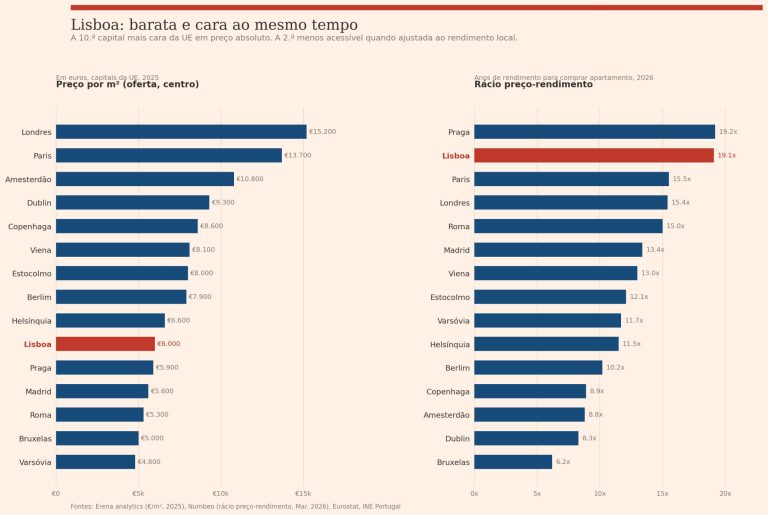
“Lisbon is cheap and expensive at the same time. It depends on who is looking.
It is common to see headlines in newspapers along the lines of “House prices in Lisbon are among the highest in Europe.” This information is correct but incomplete.
The problem is that comparing €/m² across capitals can be done arithmetically, but also economically. And the two tell completely different stories.
In asking price per square metre (different from transaction price), Lisbon ranks 10th among 15 European capitals (Erena Analytics, 2025). Below most capitals.
For a buyer with international income, whether Portuguese or not, Lisbon thus appears as one of the European capitals with the best value for money. Climate, safety, gastronomy, infrastructure, air connections. At around €6,000/m² versus around €15,000 in London, the decision is almost obvious.
The problem lies in the economic analysis, particularly for those who want to buy in Lisbon on an average “Portuguese” salary. Which is the vast majority.
The price-to-income ratio measures how many years of net household income are needed to buy an average apartment. According to Numbeo (March 2026), Lisbon stands at 19.1x. In other words, an average family has to spend 19.1 times its annual net salary to buy the average home.
This makes it the 2nd least affordable capital in the EU. Only Prague is worse. Someone from Lisbon needs more years of income to buy a home than someone in London (15.4x), Paris (15.5x) or Amsterdam (8.8x) (Numbeo, March 2026).
In the rental market, the picture is similar. The rent-to-salary ratio in Lisbon is 116% (Euronews, July 2025). The average net salary is not enough to cover the average rent for a one-bedroom apartment in the city centre. In London, that figure is 75%.
According to Eurostat, Portugal recorded the largest increase in housing prices in the EU in the second quarter of 2025: +17.2% year-on-year. Since 2010, prices have risen 141% (Eurostat/Euronews, 2025). Over that period, wages grew by less than 20% (OECD, average annual salary 2010–2024). In other words, housing prices grew at least 7 times faster than wages.
We are converging with other Europeans in housing prices, but we are by no means converging in disposable incomes.
A city can have high prices and high affordability (Copenhagen, Amsterdam). Or relatively low prices and low affordability (Lisbon).
Lisbon is therefore a kind of Schrödinger’s city, simultaneously one of the cheapest capitals in Europe and one of the most expensive.”
João Grilo via LinkedIn