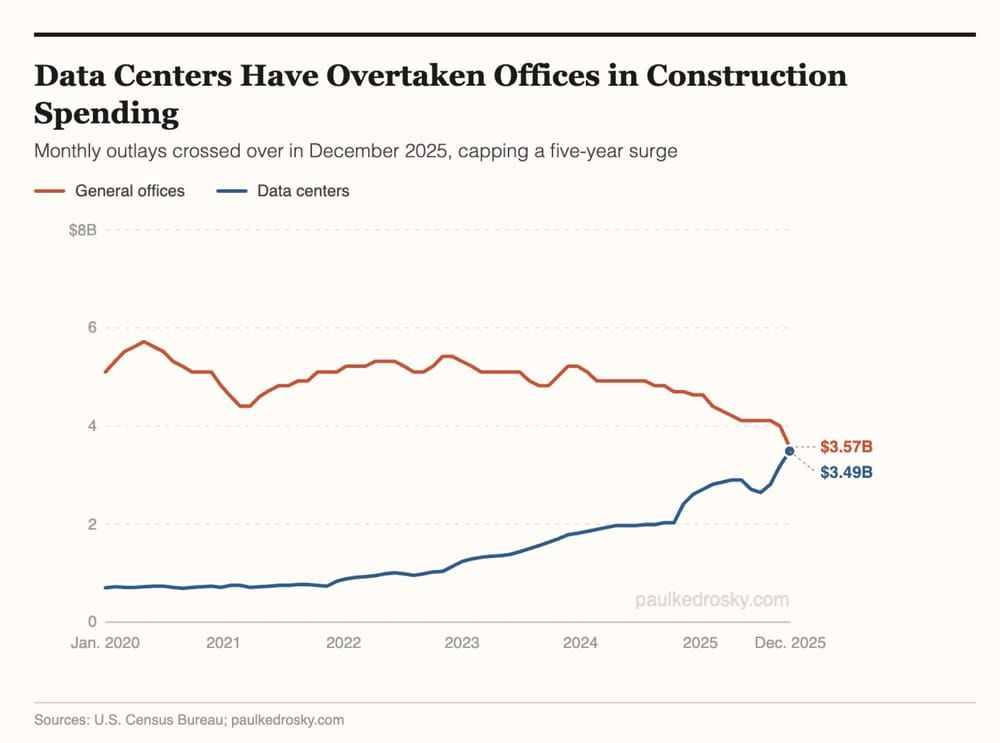
” In December 2025, for the first time, more was spent building data centers than offices in the U.S.: $3.57 billion versus $3.49 billion (U.S. Census Bureau). This isn’t surprising, as it confirms a trend that has been observable for several years.
Two forces are behind this, both structural. The first is new demand: AI needs data centers, and the scale at which it is being adopted is driving construction. The second is older demand that has shrunk: post-COVID hybrid work has permanently reduced the need for office space. Capital that once flowed into one asset class has shifted to another.
In Portugal, the dynamics are different and the scale is not comparable, but the underlying logic is similar.
For offices, what matters most is proximity to urban centers, transport, and talent, human geography. For a data center, what matters is proximity to the high-voltage power grid and to areas with available cooling, infrastructure geography. The overlap between the two is almost nonexistent, and that’s where the shift in the relative value of certain assets comes from.
For those investing in real estate in Portugal, this means that land which used to be worth little (far from transport, far from city centers, with limited residential flexibility) may begin to gain value for other reasons. It doesn’t mean that any industrial plot automatically becomes a goldmine; it means that the valuation criteria we’ve used for decades are being rewritten by the emergence of new uses (AI being the most obvious).
I believe we’ll observe these trends in Portugal as well, with some delay and on a much smaller scale.”
João Grilo via LinkedIn