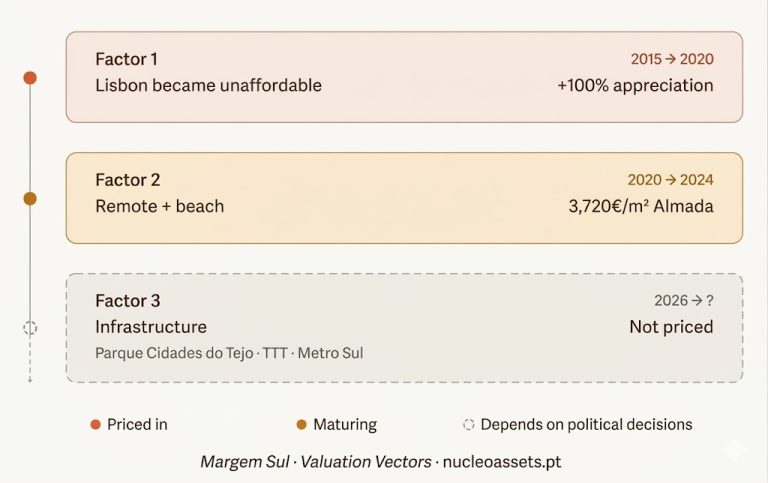
“In January 2026, the average asking price in Almada reached €3,720 per square meter, up 25.8% in a year (Idealista, Jan. 2026).
Those who bought a few years ago have seen record appreciation. Anyone buying today needs to understand what fueled that surge in order to anticipate what might come next.
The south bank of the Tagus has always had beaches. It has had universities, factories (e.g. Autoeuropa), and bridges for decades. None of that is new. None of it explains why prices have skyrocketed over the past six years rather than the previous twenty.
Part of the increase reflects broader national market trends. Another part can be traced to local dynamics.
My view is that the first factor was Lisbon becoming increasingly unaffordable. From around 2015, families and young couples who wanted to buy north of the Tagus were priced out. The south bank of the Tagus absorbed that demand, not because of its own pull, but by default. Between 2018 and 2024, Seixal, Setúbal, and Barreiro saw prices more than double (INE).
The second factor came with COVID. Remote work reshaped the equation: if you don’t need to be in Saldanha at 9 a.m., you can live by the beach. Costa da Caparica shifted from being a lifestyle perk to a deciding factor. This brought in a buyer profile that had previously been far less present on the south bank of the Tagus.
Both of these factors have already played out. At this point, they are largely priced in.
The question is whether new factors are emerging now or in the near future.
On paper, they are. The Parque Cidades do Tejo project envisions 28,000 homes and 94,000 jobs on land formerly occupied by Lisnave, Quimiparque, and the old National Steelworks (Government of Portugal, Apr. 2025). A third Tagus crossing, under various proposed routes, would reshape mobility across the entire region. The expansion of the South Bank Metro to Costa da Caparica has a five to seven year horizon (Almada Online / TML, Jul. 2025).
But none of these projects has a firm, confirmed timeline. All depend on political decisions, not just market forces.
This is where the analysis becomes more nuanced. Buying on the south bank of the Tagus in 2026 with a 2019 mindset means buying into a story that has already played out. Entry margins are tighter now, and the risk of overpaying relative to fair value is increasingly real.
And buying based on a hypothetical third factor is more a bet on politics than on the market.
As the name suggests, cycles don’t simply end. But if you don’t know which factor you’re buying into, you’re likely to pay the wrong price.
Which factor are you taking into account in your real estate investment decisions in the Lisbon Metropolitan Area in 2026?“
João Grilo via LinkedIn