“Comparing the S&P 500 with real estate is a bit like comparing apples and oranges. Yet it is a comparison you see all the time, often without enough context.
Here is how I look at it.
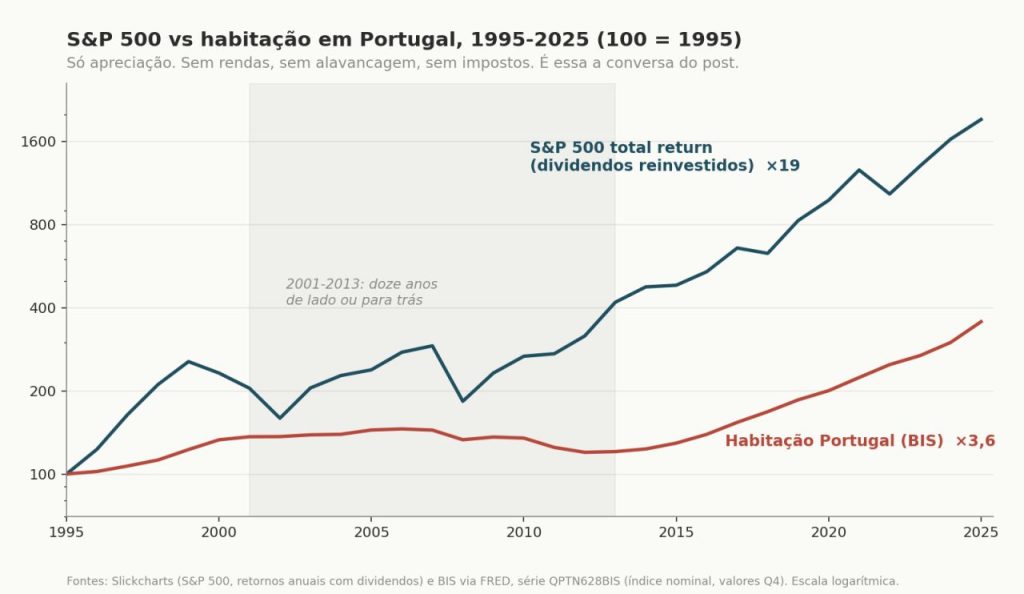
The S&P 500 has returned roughly 10% a year on average over the past 30 years. With dividends reinvested, that would have turned the original investment into around 18 times its value.
Residential property in Portugal appreciated by about 4.3% a year over the same period, based on BIS data from 1995 to 2025. That includes roughly 12 years of stagnation or falling prices between 2001 and 2013.
Looked at this way, there would not be much of a debate: invest in the S&P and forget about real estate.
The problem is that this comparison only looks at capital appreciation.
It ignores rental income, which continues to come in while the property itself appreciates. At the end of 2025, the average gross rental yield in Portugal was around 6.5%, according to Idealista. In that sense, real estate behaves a little like a stock that pays out income while continuing to grow in value.
It also ignores leverage, which is one of the most interesting characteristics of real estate as an investment vehicle.
Banks will typically finance 80% to 90% of a property purchase. They generally will not do the same for equities.
With €100k of equity, you can control €500k worth of property. A 4.3% increase in value plus a 6.5% gross yield on €500k amounts to €54k a year.
Of course, that is before taxes, maintenance, financing costs and everything else. And in years when property prices fall, leverage works exactly the same way, just in the wrong direction.
Taxation is less straightforward.
Rental income is taxed at a maximum rate of 25%, and potentially less under longer-term leases, affordable-rent schemes or temporary incentives such as those currently in place. Capital gains on shares are generally taxed at 28%.
But with property held personally, you also have to account for capital gains taxation, with 50% of the gain generally included in taxable income, as well as IMT, stamp duty and annual property tax. Equities do not carry those costs, so much of the apparent tax advantage disappears.
I would love for real estate to win this part of the comparison, but unfortunately it is difficult to make that case.
On the other hand, the S&P 500 has something no property can offer: it is genuinely passive and highly liquid.
Nobody calls an Apple shareholder because there is water coming through the ceiling, and you do not need a promissory purchase agreement and several months of waiting to exit your position.
Apples and oranges.
Personally, I prefer real estate. That does not mean it is objectively better or worse.
A proper comparison has to include leverage, rental income, taxes and the amount of work involved, all on the same spreadsheet.“
João Grilo via LinkedIn