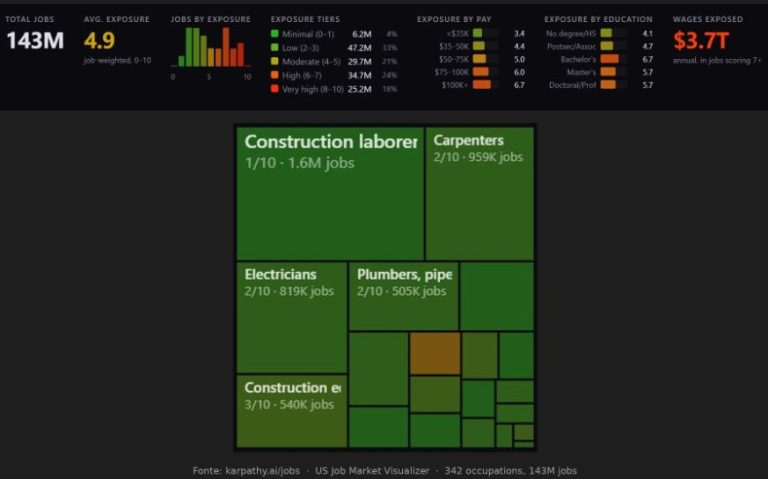
“Andrej Karpathy published a map of AI exposure across 342 professions in the U.S.
For those unfamiliar: he’s a co-founder of OpenAI, former Director of AI at Tesla, holds a PhD from Stanford, and was named by Time as one of the 100 most influential people in AI. He also coined the term “vibe coding.” He’s one of the most credible voices in the field.
According to the study, if your work lives inside a screen, exposure is high. If it requires physical presence and decision-making in unpredictable environments, AI still falls short. For example:
Developers, financial analysts, legal work, etc.: (high exposure, 8–9/10)
Professions earning over $100k/year: (moderate exposure, 6–7/10)
Electricians, plumbers, bricklayers, etc.: (low exposure, 2/10)
Construction sits at the most protected end of the spectrum. Today’s AI has no body. It is primarily software designed to process text, code, numbers, and images, everything digital. For physical work to face the same level of exposure as financial analysts or developers, robotics would need to evolve at the same pace as language models, and it is not even close.
LLMs double in capability within months. Meanwhile, the most advanced robots, Tesla, Boston Dynamics, etc., still struggle with stairs and uneven terrain. Handling complex environments and the millimeter-level tolerances that are part of everyday work on construction sites remains extremely difficult. And even if the robots worked, there is still the issue of scale: production costs, logistics, maintenance in harsh environments. Building a robot that can do what a bricklayer does is not a machine learning problem, it is a challenge in mechanical engineering, materials, energy, and unit economics. The convergence between robotics and the market still seems years away.
In the meantime, here is the paradox for those working in real estate investment: the part of our job that AI now does better than we do is exactly what we thought set us apart. Analyzing deals, running scenarios, comparing cap rates, this now takes minutes, and everyone already has or soon will have access to it.
What remains rare is what we never valued enough. Negotiating over the phone with an owner who does not want to sell, there is still lag, and non-English language handling is far from natural. Looking at a wall and knowing whether the issue is structural or cosmetic. Knowing that a street doesn’t really trade, even when the data suggests it does. Getting a construction team to deliver on time.
Tile setters, plumbers, and metalworkers are not replaceable by any language model. The shortage of skilled labor is not going away anytime soon. And that makes two assets increasingly valuable: competent people on the ground and physically rehabilitated properties.
The AI revolution is asymmetric, and that asymmetry favors those who work on the ground.”
Source: karpathy.ai/jobs
João Grilo via LinkedIn